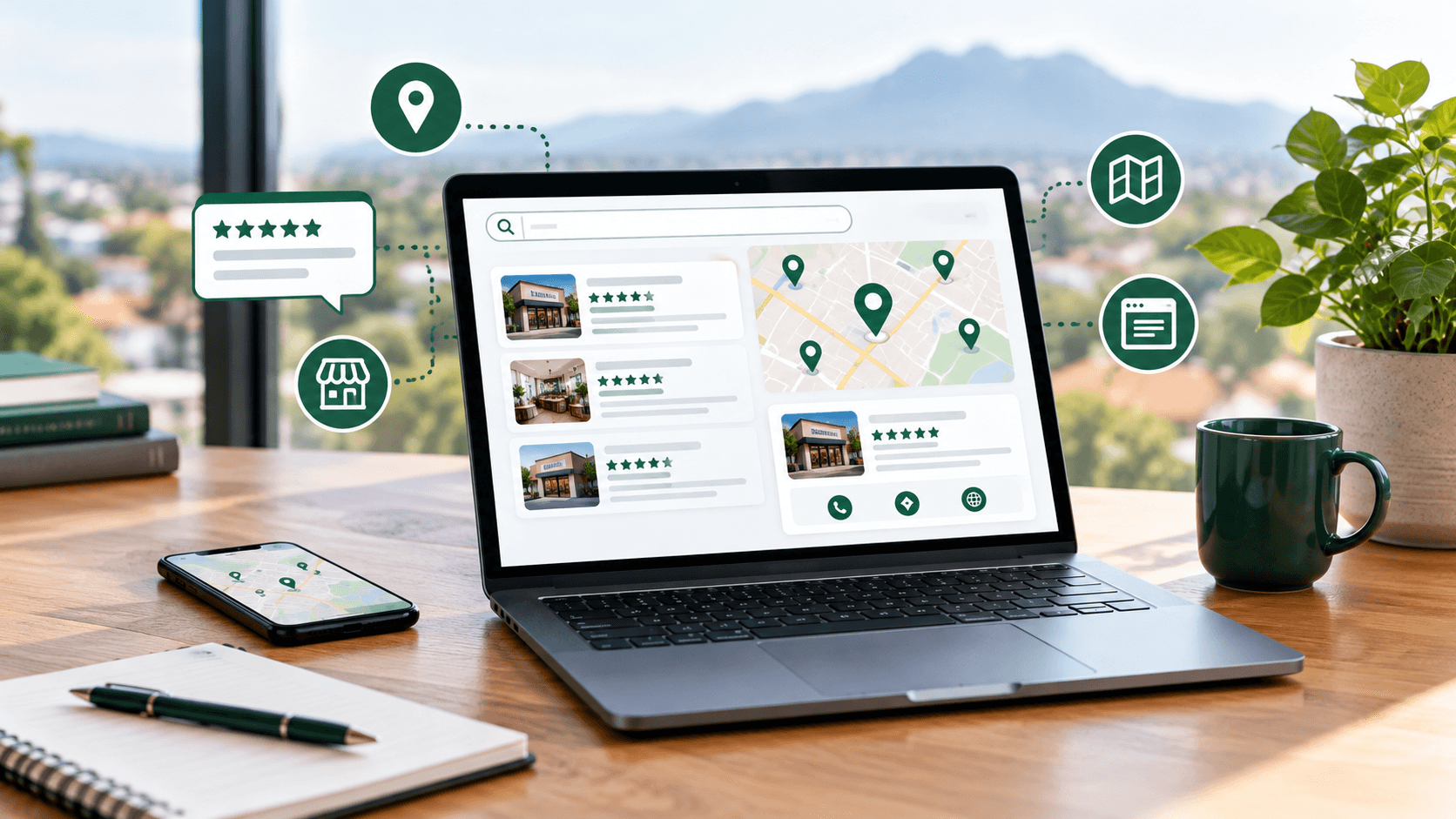
A small business does not need to create dozens of nearly identical pages to explain where it operates. It needs to make its real location, services and customer relevance clear.
Local search optimisation can help customers discover businesses when they look for a nearby service, a provider in a particular town, or a business that serves their area. But local SEO becomes counterproductive when businesses publish thin location pages, claim places where they have no genuine presence, or list service areas they cannot realistically serve.
Google's guidance on representing a business and its local business structured data provides a useful foundation: represent the business accurately, provide relevant information and follow the rules for the features you want to use.
This article explains how South African small businesses can build useful local SEO signals without creating doorway pages or misleading potential customers.
What is local SEO?
Local SEO is the work of helping a business become more discoverable for searches with a geographic or local-service intent.
Examples include searches for a service in a town, a nearby shop, or a provider that travels to customers. The appropriate strategy depends on whether the business has a customer-facing premises, serves customers at their locations, or operates through another legitimate model.
Local SEO can involve:
- An accurate Google Business Profile.
- A useful website with clear service information.
- Correct business contact details.
- Genuine customer reviews.
- Relevant local references and links.
- Clear information about where and how the business operates.
- Structured data that accurately describes the business.
- Monitoring visibility and enquiries to identify what is working.
These activities support one another, but none guarantees a particular ranking.
1. Start with the real business, not a list of keywords
Before creating pages, write down the facts that customers need to understand.
Ask:
- What services does the business actually provide?
- Where is the business based?
- Do customers visit the premises?
- Does the business travel to customers or deliver to them?
- Which locations can it serve reliably?
- Are there genuine differences in availability, pricing, travel arrangements or service delivery between locations?
These answers determine the appropriate website structure and business listing.
A business based in Soshanguve, for example, should explain its real operating arrangements and service area. A company with an actual office in Centurion may have different location information from a contractor who travels to customers in surrounding areas.
Likewise, a business serving customers in Maboloka and nearby communities should describe that service accurately rather than automatically claiming a much larger region.
These are examples of how any business can communicate its coverage. Mentioning a place on a page does not, by itself, establish that the business operates there or can serve customers there.
2. Set up Google Business Profile accurately
For eligible businesses, Google Business Profile is an important source of local business information.
Review the profile for:
- Correct business name.
- Appropriate primary and additional categories.
- Accurate telephone number and website.
- Correct opening hours.
- Relevant services.
- Suitable photos.
- A valid address or service area, depending on the business model.
Google's guidelines for representing your business emphasise accurate real-world business information. A virtual office or mailing address should not be presented as an eligible customer-facing location when the business does not actually operate there.
Understand storefront and service-area businesses
Google distinguishes between businesses that serve customers at their premises and businesses that visit or deliver to customers.
A service-area business generally serves customers at their locations rather than receiving them at its own address. A hybrid business does both.
According to Google's service-area guidance:
- A service-area business should remove its address from the profile if it does not serve customers there.
- A service-area business should use one profile for the overall area it serves, rather than creating a separate profile for every town.
- Businesses can specify up to 20 service areas using cities, postal codes or other supported areas.
- The service area should be accurate and generally within about two hours' driving time of the business's base.
Google does not let businesses define service areas as a simple radius in the current guidance. Select the actual areas served instead.
Do not create profiles for imaginary branches or use an address that does not qualify. A misleading listing may confuse customers and put the profile at risk.
3. Decide whether a location page is genuinely needed
One of the most common local SEO mistakes is creating a page for every town that appears in keyword research.
Consider a business with one service page and a list of towns. It may be tempting to copy that page repeatedly, replacing the town name in the heading, title and body.
If the pages contain substantially the same information and funnel visitors towards the same destination, they may provide little value. Google's spam policies describe doorway abuse as creating similar pages or sites to target specific searches and lead users to a common destination.
The solution is not to avoid location information altogether. It is to create pages that answer real customer questions.
When a location page makes sense
A dedicated page may be useful when it serves a distinct purpose, such as:
- Explaining the services available from a genuine branch.
- Providing practical information for customers visiting that location.
- Describing a meaningful difference in service delivery.
- Answering location-specific questions that cannot be answered adequately on a general page.
- Helping customers understand travel arrangements, access, appointment availability or delivery options.
A page should contain enough useful information to justify its existence.
When a separate page may not be necessary
A separate page is often unnecessary when the only difference is a town name.
If a business provides the same service in several nearby towns and there is no meaningful difference in how customers are served, a well-written service-area section or a single comprehensive service page may be more useful.
The goal is to help customers make decisions, not to maximise the number of URLs on the website.
4. Make each page useful before making it location-specific
A strong service or location page should answer the questions that matter to a potential customer.
Depending on the business, useful information may include:
- What the service includes.
- Who the service is suitable for.
- How the process works.
- What information the customer needs to provide.
- Whether an appointment is required.
- How pricing or quotations are handled.
- What affects availability.
- How the customer can make contact.
- Which locations are genuinely served.
- What happens after an enquiry.
Add location details where they help answer these questions.
For example, a home-service business might explain whether customers in a particular area can book an appointment, how travel is arranged, and whether any service limitations apply. A shop might provide directions, parking information and accurate opening hours.
Do not manufacture local details, testimonials, customer stories or photographs. If there is no meaningful local information to add, reconsider whether a separate page is necessary.
5. Use a simple, understandable website structure
Local SEO does not require a complicated website architecture.
A small business might organise its content like this:
- Home: what the business does and how to contact it.
- Services: the main services offered.
- Individual service pages: more detailed information about important services.
- Location or service-area information: genuine premises or useful information about the areas served.
- About: background that helps customers understand the business.
- Contact: reliable contact information and relevant directions or service arrangements.
Not every business needs every page. The structure should reflect the actual service model and the questions customers ask.
Use descriptive internal links so visitors and search engines can understand the relationship between related pages. Avoid creating large collections of nearly identical URLs just because a keyword tool shows different town names.
6. Use local business structured data carefully
Structured data helps describe information on a page in a format that search engines can process.
Google's LocalBusiness structured data documentation explains how supported properties can describe details such as a business name, address, telephone number and opening hours.
Before implementing it:
- Identify the correct business type.
- Include information that is genuinely accurate.
- Make sure the markup reflects visible, relevant page content.
- Validate the markup using Google's testing tools.
- Check that the page can be crawled and indexed.
- Review any errors or warnings that matter to the intended feature.
Do not use structured data to claim locations, reviews or services that do not exist. Google explicitly states that valid markup does not guarantee that a search feature will appear.
Structured data is a way to describe real information, not a shortcut for creating local authority.
7. Build trust through consistent business information
A potential customer may encounter the business through its website, Google Business Profile, a directory or a social profile.
Inconsistencies can create confusion. An outdated telephone number or different business name may cause customers to question whether they have found the right provider.
Create a simple record of the business's approved information:
- Public business name.
- Main telephone number.
- Website address.
- Actual business address, where applicable.
- Opening hours.
- Primary services.
- Genuine service areas.
- Links to official business profiles.
Review these details when something changes. Avoid creating multiple versions of the business name solely to include more keywords.
Local mentions and links can also be useful when they arise naturally from real business relationships, community involvement, relevant directories or useful contributions. Do not buy or manufacture links simply to manipulate rankings.
8. Encourage genuine reviews and respond professionally
Reviews can help customers understand what to expect from a business. They may also influence whether a potential customer chooses to make contact.
Ask customers for honest feedback using an appropriate, permitted process. Do not write fake reviews, impersonate customers or offer incentives in exchange for positive ratings.
Respond professionally to feedback. Thank customers for useful comments, address legitimate concerns and avoid revealing private customer information in public responses.
A negative review should not automatically lead to a defensive response. Explain what can be done to resolve the issue and, where appropriate, move the discussion to a private channel.
Reviews should reflect actual customer experiences. They are not a substitute for accurate service descriptions, reliable operations or useful website content.
9. Measure outcomes, not just keyword positions
Local SEO should be assessed against the business's objectives.
Useful measurements may include:
- Relevant organic search traffic.
- Visits to important service and location pages.
- Calls or enquiries from eligible business listings.
- Form submissions and qualified leads.
- Search terms that reveal customer intent.
- Changes in the accuracy and completeness of business information.
- Whether visitors can find the information they need.
Separate visibility from business outcomes. A page may attract visits without generating useful enquiries, while a page with less traffic may serve a valuable customer group.
Use available analytics and search reporting tools to identify patterns. Review the quality of enquiries as well as their volume.
Want to understand where your local SEO work should start? Focus first on factual accuracy, useful service information and the customer journey before adding more pages.
SEO assessment: Request an assessment from Mogen to discuss your website's search visibility and identify possible areas for improvement.
10. A practical local SEO review
Use this checklist during a monthly or quarterly review:
- Business details are accurate across important profiles.
- The Google Business Profile reflects the real business model.
- Service areas include only places genuinely served.
- The website clearly explains the services offered.
- Every location page has a useful reason to exist.
- Pages are not near-identical copies targeting different town names.
- Contact details and important links work.
- Structured data reflects accurate information.
- Reviews are genuine and handled professionally.
- Search and enquiry performance is reviewed.
- Outdated pages and claims are corrected or removed.
This process is more sustainable than continually creating pages to target every possible location keyword.
Web development and SEO options:
Visit Mogen's website to explore available services and discuss how your website can present your business more clearly online.
Frequently asked questions
Should I create a page for every town I serve?
Not automatically. Create a dedicated page when it provides distinct, useful information for people in that location. Otherwise, one comprehensive service page with accurate coverage information may be more appropriate.
Can a service-area business have a Google Business Profile?
Eligible service-area businesses can have a profile. They should represent their operating model accurately and follow Google's requirements for addresses and service areas.
Does adding a town name to every heading improve local SEO?
Repeating place names does not make a page useful by itself. Use geographic information naturally where it helps customers understand availability, service delivery or location-specific details.
Does local business structured data guarantee a higher ranking?
No. Structured data can help search engines understand information and may support eligibility for supported search features, but it does not guarantee a particular ranking or appearance.
Conclusion
Sustainable local SEO starts with accurate information and a useful customer experience. An honest business profile, clear service pages, genuine reviews and well-chosen location content provide a stronger foundation than dozens of copied pages.
Before publishing another location page, ask one question: does this page help a real customer make a better decision? If the answer is unclear, improve the existing content first.